
Blogs
Why Network Address Translation Matters More Than Most People Realize
When people think about the internet, they usually imagine websites, apps, video calls, and messages moving instantly across the world. Few stop to think about the hidden traffic management that makes all of this possible. One of the most important of those hidden systems is Network Address Translation, or NAT.
At its simplest, NAT is a method that allows multiple devices on a private network, such as the phones, laptops, TVs, and smart speakers in your home, to share a single public internet address. Your router sits between your home network and the wider internet, translating private local addresses into a public one when traffic goes out, then directing responses back to the right device when traffic comes in.
That may sound technical, but its role is deeply practical. NAT helps conserve scarce internet address space, adds a layer of separation between your devices and the public web, and makes modern connected life more affordable and manageable. Without it, everyday internet use would look very different.
What NAT actually does inside your home or office
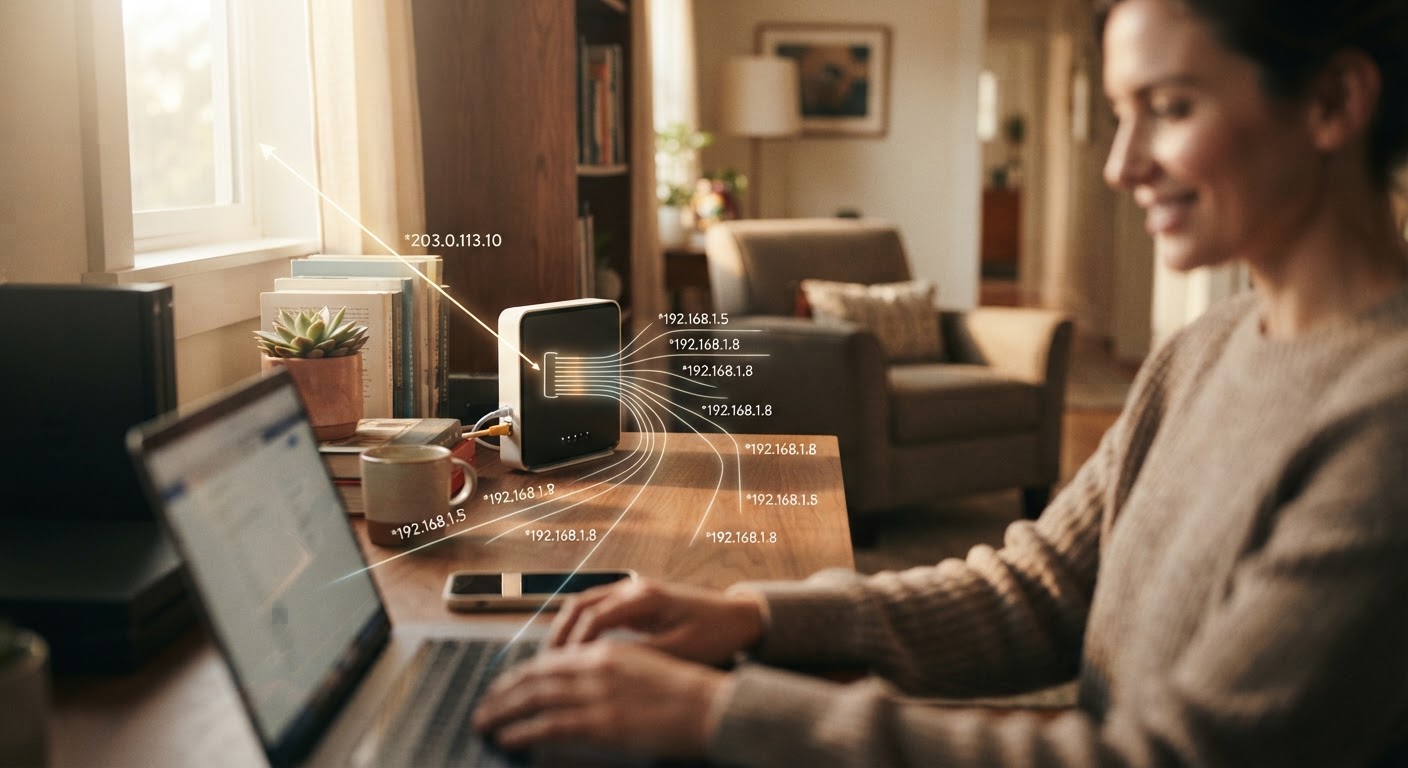
Every device on a network needs an address so data knows where to go. Inside your home, your router assigns private addresses to devices, often beginning with ranges like 192.168.x.x or 10.x.x.x. These addresses work locally, but they are not meant to be visible across the public internet.
When one of your devices opens a website or streams a movie, the router rewrites the outgoing traffic so it appears to come from your home’s public IP address instead of the device’s private one. It also keeps track of which request belongs to which device. When the reply comes back, the router translates the address information again and sends the data to the correct phone, tablet, console, or computer.
This translation process is why a family of five can all be online at once, using one internet connection and usually one public-facing IP address. It is also why small businesses can connect dozens or hundreds of internal devices without needing a public address for each one.
Why NAT became essential to the growth of the internet

The biggest reason NAT became so important is a basic supply problem. The older addressing system used by much of the internet, IPv4, has a limited number of public addresses. That number sounded enormous when the internet was young, but it was nowhere near enough for a world filled with smartphones, home broadband, cloud systems, smart appliances, industrial sensors, and connected cars.
NAT acted as a workaround to this shortage. By letting many devices share one public address, it dramatically reduced the number of public IPv4 addresses needed. This made internet access cheaper, easier to scale, and more realistic for homes, schools, companies, and service providers.
In that sense, NAT did not just solve a technical inconvenience. It helped buy time for the internet to keep expanding. Without NAT, the shortage of IPv4 addresses would have become a much bigger barrier much earlier, slowing the spread of consumer internet access and connected services.
Even today, although IPv6 offers a vastly larger pool of addresses, NAT remains deeply embedded in networks around the world because so much infrastructure still relies on IPv4 and the habits built around it.
How NAT affects your daily life without you noticing

NAT shapes ordinary life in quiet ways. When your household streams different shows in different rooms, joins a video meeting, backs up photos to the cloud, and checks a doorbell camera at the same time, NAT helps your router juggle those separate connections behind one internet-facing address.
It also helps internet service providers manage millions of customer devices efficiently. Many mobile and broadband providers use forms of carrier-grade NAT to allow large numbers of users to share limited public IP resources. That is one reason internet access can be offered at mass scale and relatively low cost.
NAT also influences how easy or difficult some online activities feel. Most web browsing, streaming, shopping, and social media use work perfectly well through NAT because those services are built around outbound connections that your device starts.
But some applications can run into friction. Online gaming, voice and video services, remote access tools, peer-to-peer apps, and smart home setups may sometimes need special configuration because devices behind NAT are not automatically reachable from the outside world. That is why people sometimes hear terms like port forwarding, strict NAT type, or double NAT when troubleshooting connectivity problems.
So NAT is both an enabler and, occasionally, a complication. It makes widespread connectivity practical, but it can also add layers that certain services must work around.
The security benefit people often misunderstand
NAT is often described as a security feature, and there is some truth in that, though it is important not to overstate it. Because NAT hides internal private addresses from the public internet and generally blocks unsolicited incoming connections unless configured otherwise, it creates a useful boundary between your devices and outside traffic.
That means your laptop or smart thermostat is not automatically exposed in the same direct way it might be on a fully public network. For ordinary home users, this can reduce accidental exposure and make the network less open to random inbound probing.
Still, NAT is not the same thing as a firewall, antivirus tool, or broader cybersecurity strategy. It provides obscurity and controlled translation, not comprehensive protection. Real security still depends on proper router settings, software updates, strong passwords, encryption, and careful user behavior.
In other words, NAT helps, but it is not magic. Its importance lies in practical risk reduction and network control, not in replacing genuine security measures.
Why NAT still matters in the future
Some technologists hoped NAT would fade away as IPv6 adoption grew, because IPv6 offers enough addresses for an enormous number of devices without the same scarcity problem. And over time, some uses of NAT may indeed become less central.
But technology does not change all at once. The world runs on mixed systems, old hardware, transitional services, and business realities. NAT remains important because it supports compatibility, cost control, network organization, and operational simplicity in environments that still depend heavily on IPv4.
It also reflects a broader truth about infrastructure: the internet survives not only because of elegant design, but because of practical adaptations. NAT is one of those adaptations. It is not glamorous, and most users never see it, yet it has quietly supported the rise of connected modern life.
The next time your phone, laptop, TV, and smart speaker all work at once over one home connection, you are seeing NAT’s value in action. It matters because it stretches limited resources, organizes traffic, and helps make the internet available to far more people than would otherwise have been possible. That is why something so invisible is also so important.